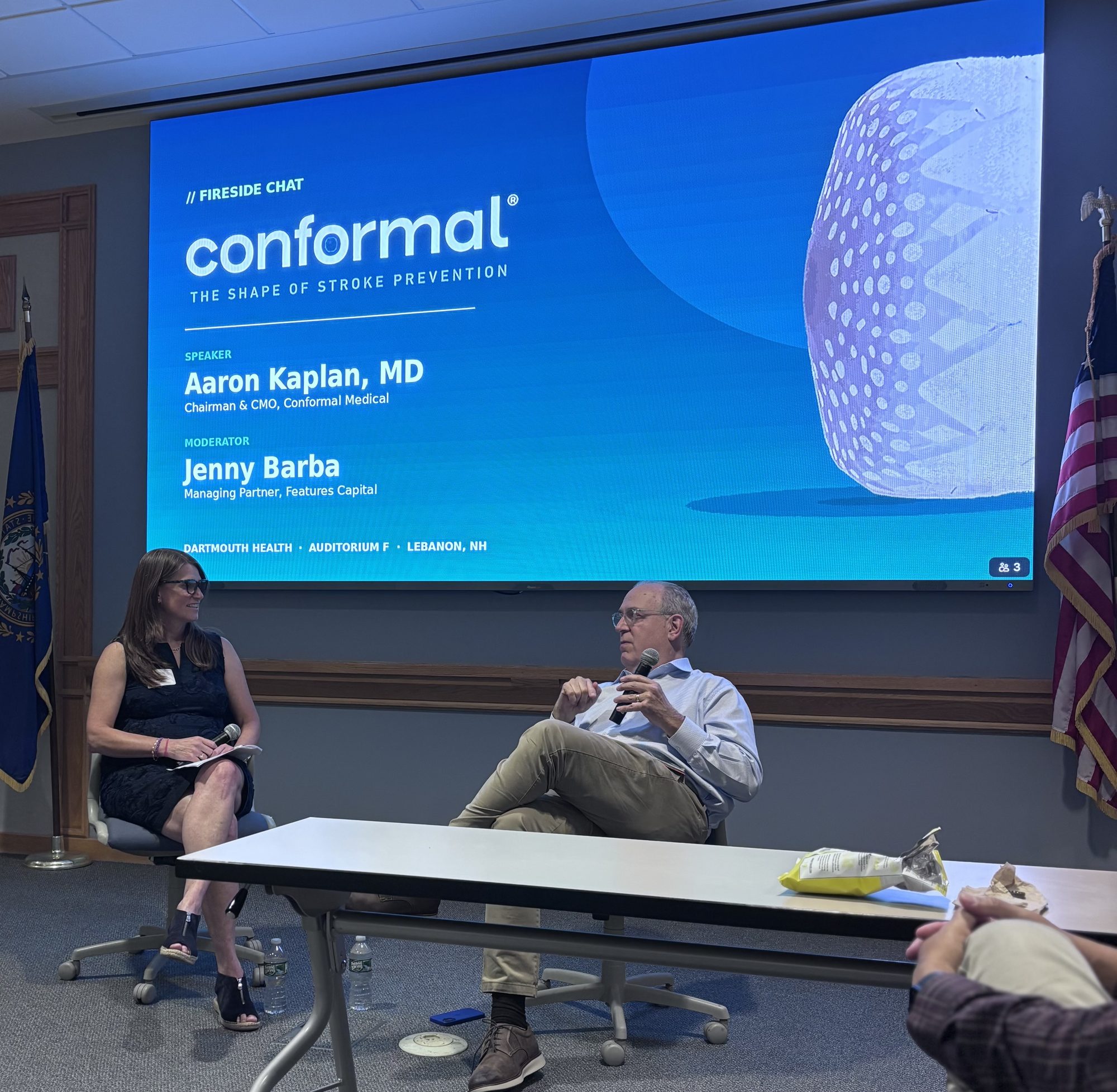
MTC's Don Castle opened the evening with a thank-you to
IdeaLab, sponsor of the event, and a look at what's
ahead on the calendar: a Hanover mixer on September 10 and the annual conference
November 12 and 13 at the Roux Institute in Portland, Maine. Then
Jenny Barba, Co-Founder and Managing Partner of Features Capital,
an early-stage MedTech venture capital firm, and a member of MTC's original board,
sat down with the evening's guest.
Aaron Kaplan, MD hardly needed the introduction; a show of hands
confirmed half the room had worked with him already. Interventional cardiologist,
engineer by training, 80-plus papers, 65 U.S. patents, founder of Perclose, Tryton
Medical, LocalMed, and Conformal Medical. What followed was a set of lessons, told
through stories.
Define the problem. Then step away.
The formative years were at Stanford, under two towering mentors: Thomas Fogarty and
John Simpson. As a fellow in the early '90s, Kaplan spent mornings holding femoral
access sites closed, sometimes for hours, sometimes two at a time. Simpson's insight
became Perclose: when surgeons repaired a damaged artery, all that dissection ended in
a single stitch. A catheter could place that stitch, and there were "miles of Texas in
the iliac artery" to house the mechanism that did it.
The lesson Kaplan carried forward: the physician's job is to define the problem and
frame constructs, then build a team of skilled engineers and managers, and get out of
their way.
If you know more than the engineer about materials, either you're delusional or he's
not the right engineer.
A dog with a bone.
Kaplan's fixation on the left atrial appendage predates Conformal by decades; his
first patent in the space is more than 25 years old. After reading surgeon James Cox's
work on removing the appendage, he tried snaring it in the animal lab with Fogarty,
funding the work 50/50. Of roughly ten animals, six survived, half developed
pericarditis, and closure was inconsistent. He abandoned the approach; "but what I
learned was, I wrote very good patents."
These are ten-year projects. Your people's careers will be based on them. Don't do
something you don't fundamentally believe in.
It was never about the foam.
The AFib math, as Kaplan laid it out: with atrial fibrillation, lifetime stroke risk
runs one in three, and blood thinners cut that risk by nearly 80 percent. Yet roughly
40 percent of patients who should be on anticoagulation aren't taking it; a figure
that holds even in systems like Sweden's. That is the gap left atrial appendage
closure exists to fill, and today's standard of care requires general anesthesia,
transesophageal echo, and three physicians per procedure, with six device sizes to
choose from.
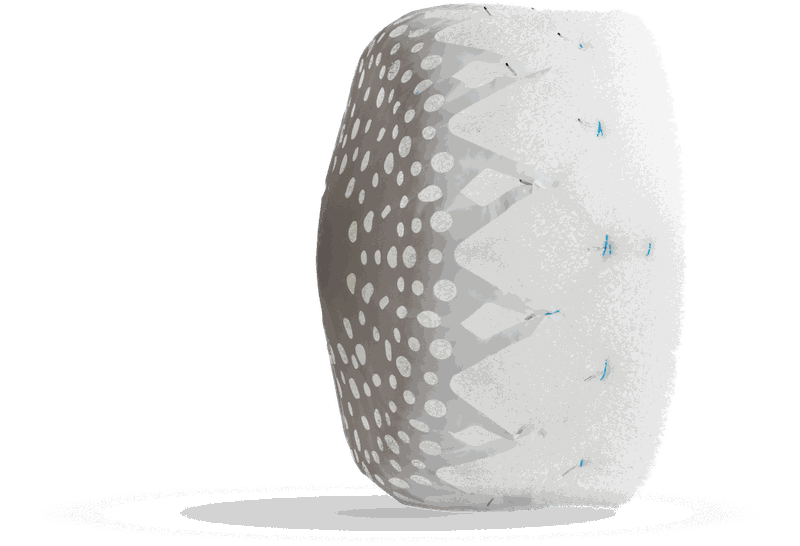
Conformal's premise inverts that: one physician, conscious sedation, and a
foam-based implant where one size fits nearly all. The foam came later, from an
unlikely paper trail through endoleak materials.
It's not the foam. It's defining the problem.
Building it in the Upper Valley.
Why leave Stanford for the Upper Valley? Partly for a patient population that
reflects the real world rather than a referral center's skew; partly for protected
time, negotiated into his recruitment; and partly for distance from coastal venture
groupthink, where "all the VCs go after the same two or three companies." Staying
clinical, he argued, is what lets a physician founder keep finding real problems.
The company itself took shape through co-founder Andy Levin, an
undergraduate friend turned Boston-area serial entrepreneur who brought the
engineering team, and through Nashua, chosen for its extrusion and catheter talent
just north of the Massachusetts line, halfway between Boston and the Upper Valley.
The financing was unusual by design: only one venture-led round, with strategic
backing, a position from Fidelity, and independent directors with deep operating
experience. The journey's newest chapter is Conformal's acquisition by W.L. Gore.
It's more important to be in a growth market than a big market.
Advice for physician founders.
Prompted by Barba, Kaplan distilled his advice for the physicians and engineers in
the room into a handful of rules.
- Keep a foot in the clinic. Leaving your day job is usually a
mistake; the clinic is where problems surface, and defining problems is the
founder-physician's real job.
- Ask the audacity question. Why do you think you should have a
better insight than all the other smart people (and there are likely many out
there) working on the same problem? Have an honest answer.
- Partner with real engineers. Find people of similar enthusiasm
and different competence, and respect the boundary between defining the problem
and engineering the solution.
- Put alignment on paper early. Most founders won't be the CEO who
scales the company. Agree up front, in writing, that recruiting your successor is
rewarded rather than punished.
- Get strong company counsel. The fund's preferred counsel gets their
repeat business from the fund. Know who your advisors actually represent.
The legacy: 3D.
The conversation closed on the Dartmouth Device Development Symposium, born from
Kaplan's observation that cardiologists, regulators, industry, and finance all study
the same problems from different seats, and rarely in the same room. The first 3D
meeting convened the day after FDA signed its letter on drug-eluting stent
thrombosis, putting the agency, the trial PI, and the manufacturer on the same stage;
"showdown at the OK Corral." The ARC consortium formed around the meeting a year
later.
Out of 3D has now come the 3D Scholars, a one-year certificate program for early and
mid-career physicians: five scholars in the first class, drawn from neurosurgery,
radiation oncology, structural cardiology, electrophysiology, and imaging, led by 3D
and starting and finishing at Dartmouth Health, with field trips to FDA, CMS
veterans, Stanford Biodesign, Fogarty Innovation, and the Twin Cities. The second
class is about to be announced.